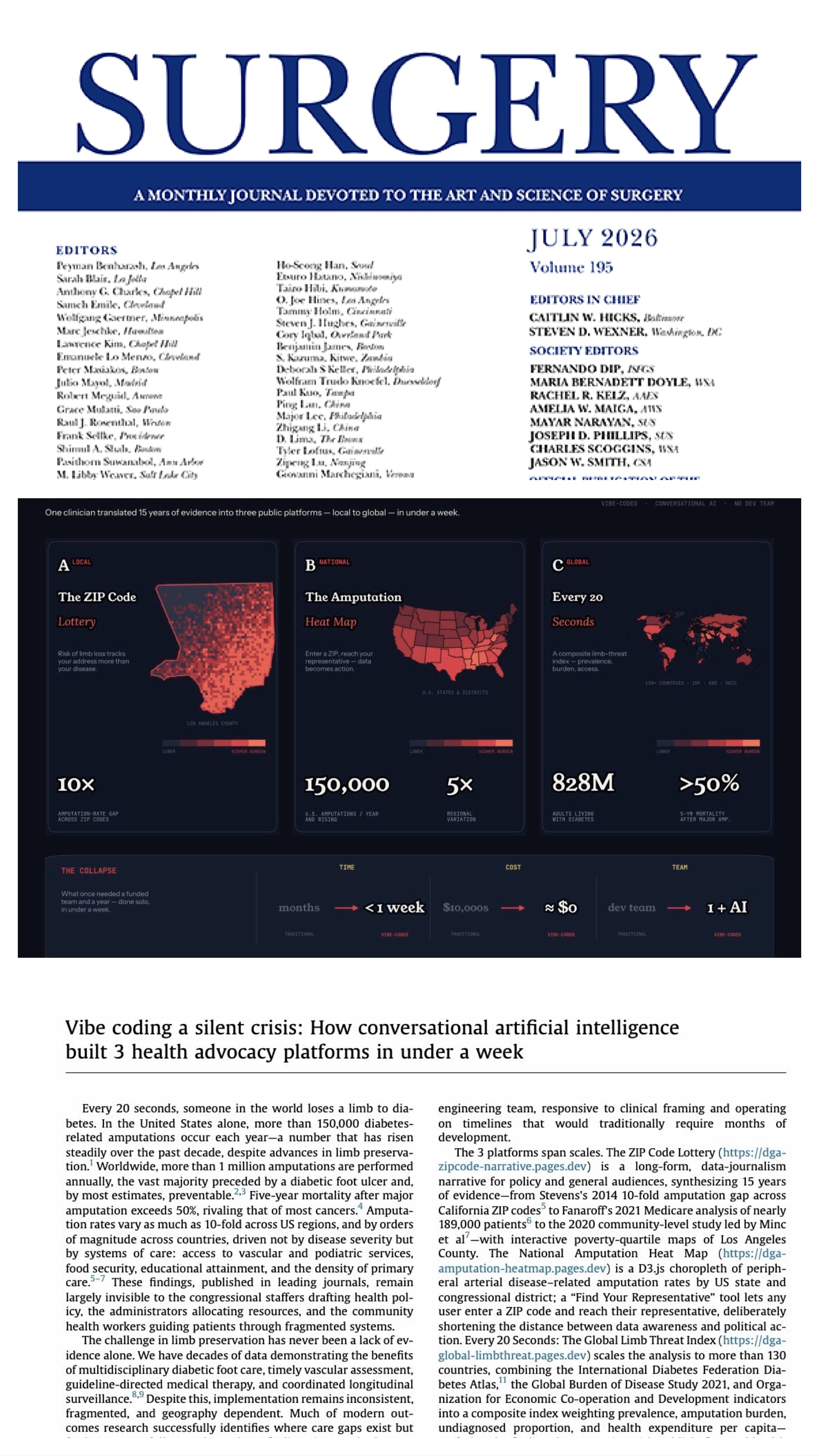
 Published in Surgery
Vibe coding a silent crisis
How conversational artificial intelligence built these three health-advocacy platforms in under a week.
Read the peer-reviewed article →
Published in Surgery
Vibe coding a silent crisis
How conversational artificial intelligence built these three health-advocacy platforms in under a week.
Read the peer-reviewed article →
150,000 Americans lose a limb every year. Most amputations are preventable. Your congressional district has a number. Do you know it?
Peripheral artery disease affects over 12 million Americans. It restricts blood flow to the limbs. When undetected and untreated, it leads to amputation — and amputation is frequently a death sentence. Five-year mortality after major amputation exceeds most cancers.
But here's the unbearable part: amputation rates vary up to five-fold between congressional districts. The South, Appalachia, and parts of the Midwest shoulder a wildly disproportionate burden — driven not by clinical severity, but by screening gaps, provider shortages, insurance barriers, and underinvestment in community health infrastructure.
The American Heart Association's PAD Collaborative built a heat map to make this visible. We've taken that data and the published evidence and made it impossible to ignore.
States shaded by estimated amputation burden based on published CMS Medicare data patterns. Darker colors = higher rates. Hover or tap for details.
The treatments that prevent amputation are well-established: screening, antiplatelet therapy, statins, supervised exercise, and timely vascular consultation. The evidence base is decades deep. And yet the delivery of these basic interventions is shockingly poor — even in well-resourced areas.
This is not a knowledge problem. It's an implementation problem. And the districts with the highest amputation rates are the same districts where these interventions are least likely to be delivered.
32% of Medicare patients who underwent amputation received zero diagnostic arterial testing in the 12 months before losing their limb. Proximity to care does not equal access to care.
— Fanaroff et al., Journal of the American Heart Association, 2021
Amputation is not just limb loss — it is a harbinger of death. Five-year mortality after major amputation exceeds that of breast, prostate, and colorectal cancer. And yet federal research funding for diabetic foot disease lags cancer funding by orders of magnitude.
Every congressional district has an amputation rate. Every representative votes on Medicare coverage, community screening programs, and health equity funding. This is their issue — whether they know it yet or not.
Enter your ZIP code to find your representative on house.gov and see your district's amputation burden on the AHA heat map.
Where interdisciplinary limb preservation teams have been deployed, amputations have been cut in half. The evidence is clear. The tools exist. What's missing is awareness, political will, and resources directed to the communities that need them most.
Use these maps. Share them. Show them to your representative.
Ask: "Do you know where we are on the amputation heat map — and what are you doing about it?"